


Securing a riverbank
Project information
Construction project
Scheibe Open-Cast Mine Residual LakeCustomer
LMBV Lausitzer und Mitteldeutsche Bergbau-</br>Verwaltungsgesellschaft mbHConstruction
NADEBOR Tief- und Landeskulturbau GmbH,</br>KrauschwitzLocation
Castle near Hoyerswerda, Germany , DEPlaning
G.U.B Ingenieur AG, Büro DresdenConstruction time
2008Products used
Project details


Situation
Scheibe Lake is to be used as a local recreational destination. However, priority is given to nature conservation in the eastern part of the lake. Since 2003, the northern shore of the lake has been increasingly subject to erosion processes. As a result of these processes, the northern beach and the stability of the embankment at the ‘Landmarke Eiche’ natural monument were endangered. Between 2006 and 2007, there were significant changes to the embankment profiles and a considerable retreat of the shoreline. This led to the formation of a 130 m long basin and, in some areas, to the formation of cliffs up to 2.80 m high. There was a risk that the stability of the rockfill at the ‘Landmarke Eiche’ would be compromised by the ongoing erosion and scour formation. For this reason, it was essential to protect the affected areas against wave-induced erosion. This was made more difficult by the presence of very uniform sands, which have a pronounced tendency to flow.
Solution
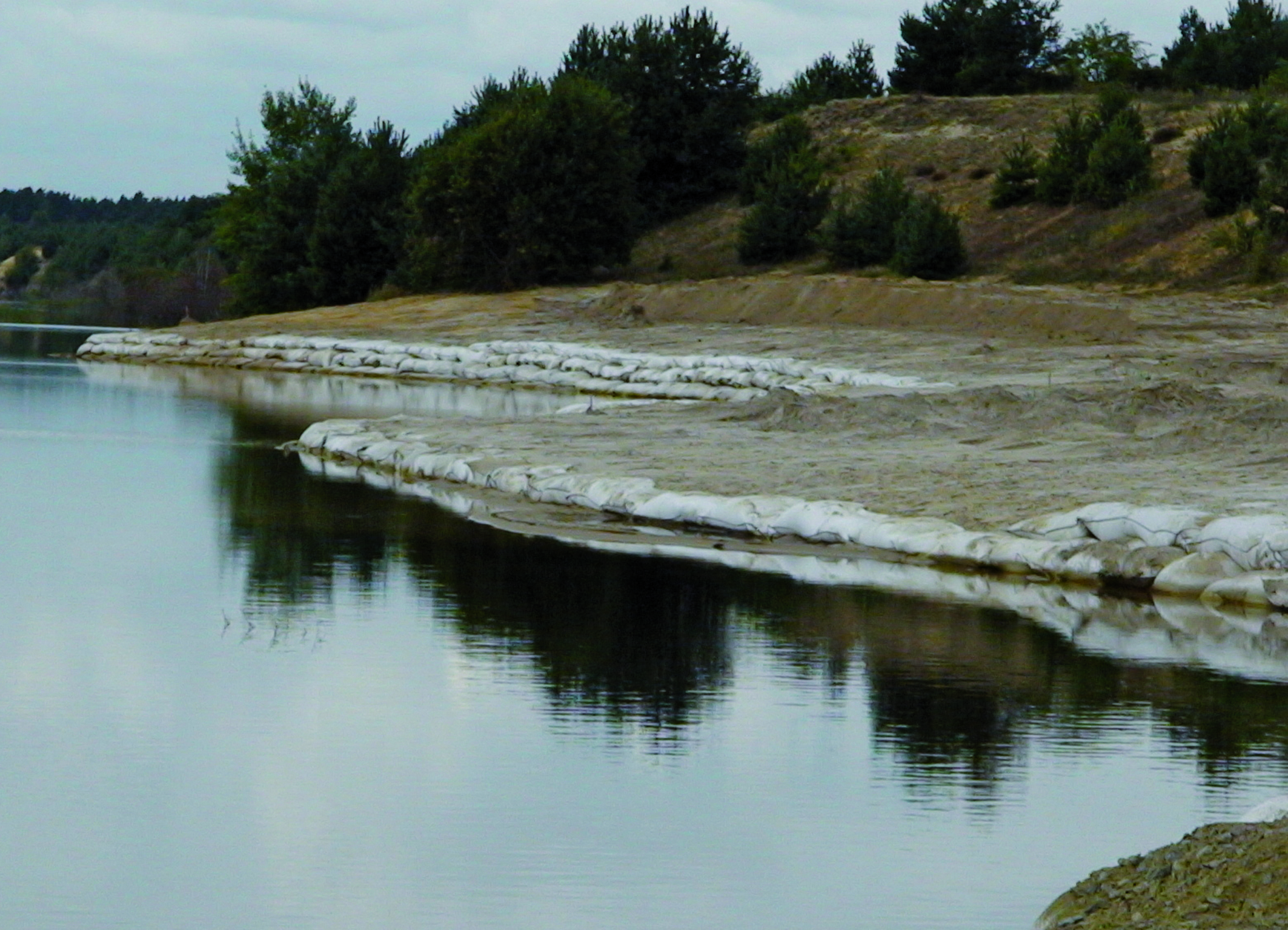
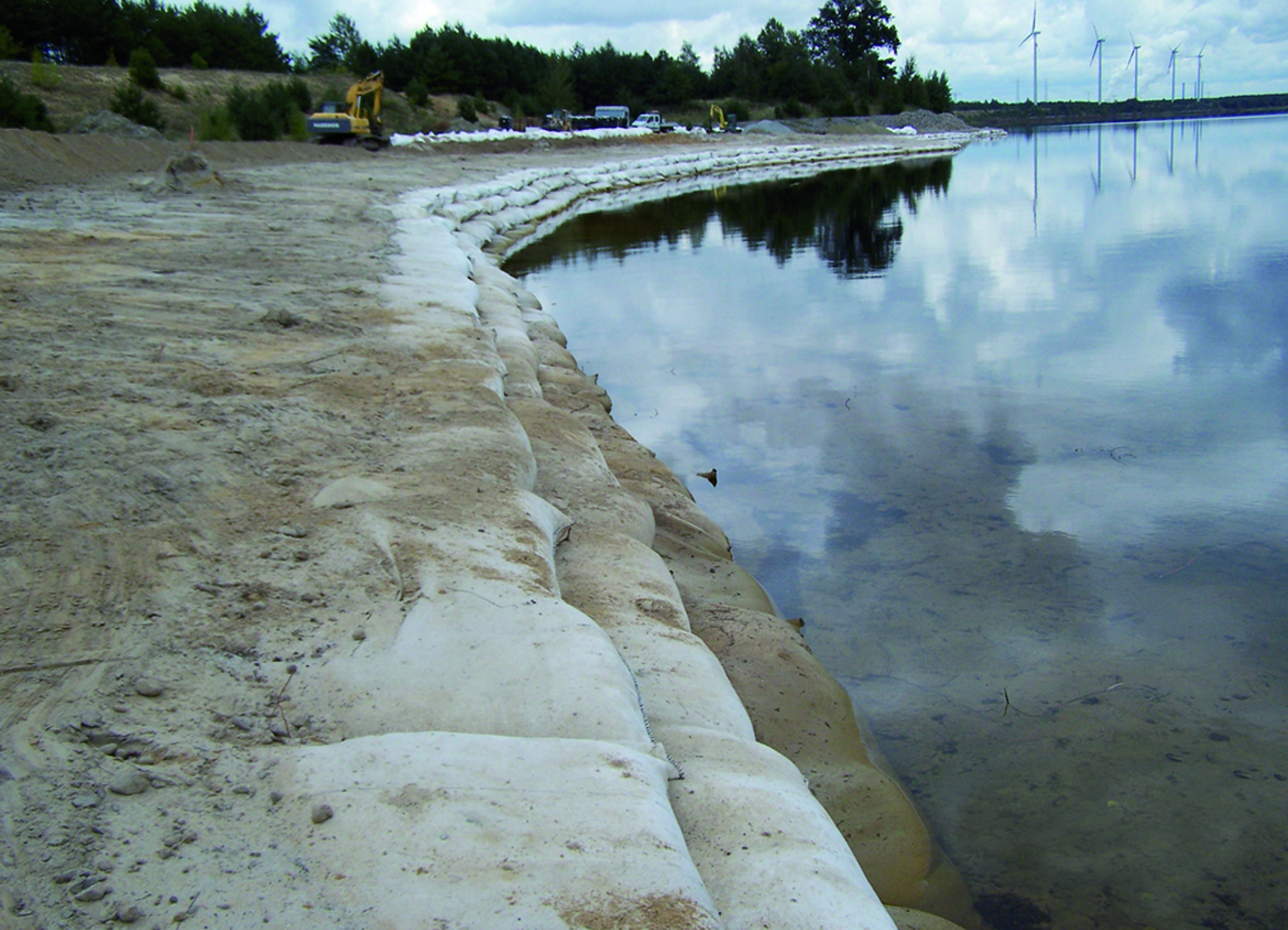
As a stabilisation measure, the installation of an erosion-resistant retaining structure in the shoreline area and in the wave run-up zone was considered. As an efficient, technically straightforward and cost-effective solution, the engineering firm G.U.B. Ingenieur AG planned the use of geotextile sand containers. The construction work involved a multi-layered, continuous shoring of the shoreline area using 1 m³ sand containers as the retaining structure. A further complication was that, in a very narrow section of the beach, the retaining structure had to serve as a working and access causeway. This was resolved by using lightweight equipment and the ‘front-end installation’ method. A particular challenge was ensuring the durability of the geotextile containers in the acidic environment, as the lake water has a pH value of 2–4. This requirement was met by using a suitable raw material (polypropylene).
Following completion of the construction phase, the survey of the front and rear edges of the reinforcement, and the assessment of the embankment by the expert appointed by the Saxon Mining Authority, it can be concluded that the embankment reinforced with geotextile sand containers has been constructed in accordance with the calculated stability analyses. The success of this project was due to the project-compliant execution in accordance with the instructions of site supervision, the detailed planning and calculations, as well as the provision of a suitable geotextile construction material.
Further information